Mandar Hill
📍 Banka (Ancient Mithila Border)
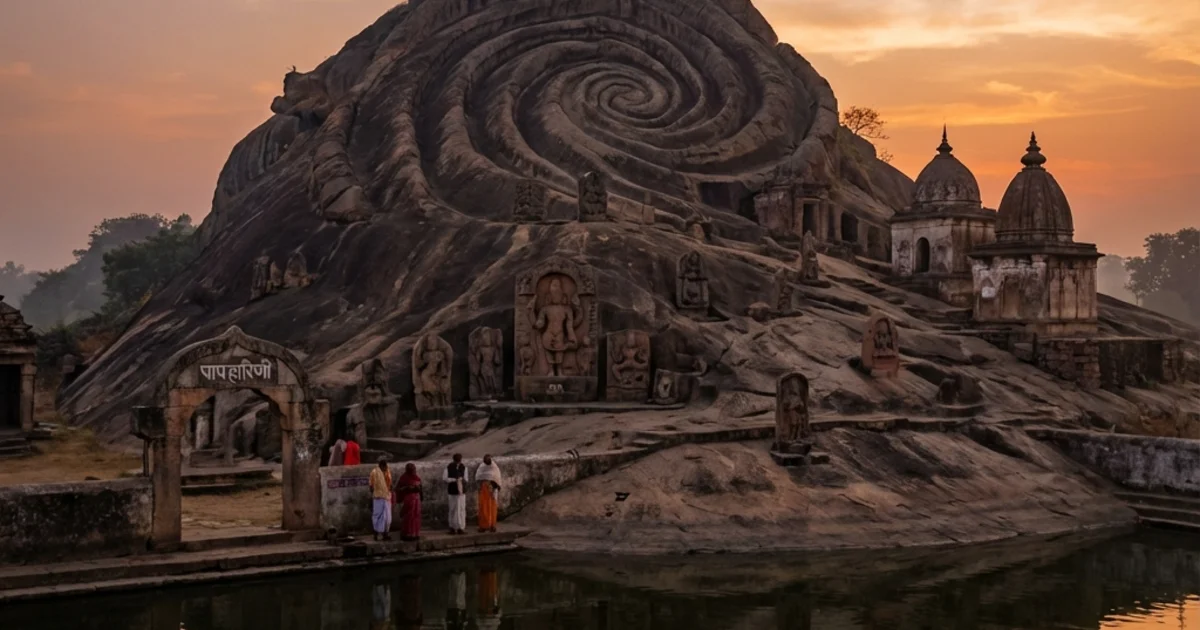
Mandar Hill, rising approximately 700 feet above the landscape in the Banka district of Bihar, stands as a monumental landmark where Indian mythology, history, and geological wonder intersect. Known in ancient scriptures as 'Mandarachala Parvata', this granite hill is famously identified as the churning rod used during the primordial 'Samudra Manthan' (Churning of the Ocean). According to the Puranas and the Mahabharata, the gods (Devtas) and demons (Asuras) used this very hill to churn the cosmic ocean of milk to extract the nectar of immortality (Amrit), with the serpent king Vasuki serving as the churning rope. Devotees point to the distinctive spiral patterns carved into the hill's surface as the eternal marks left by the great serpent's body. The hill holds deep sacredness for both Hindus and Jains, showcasing the pluralistic spirit of the region. For Hindus, it is also the site where Lord Vishnu, in his 'Madhusudana' form, is believed to have vanquished the demons Madhu and Kaitabha, who are said to lie buried beneath its massive weight. A remarkable 34-inch black stone sculpture of Vishnu in his 'Narahari' (Man-Lion) incarnation, dating back to the Gupta period, is found on the hill, notable for its serene and unique artistic representation. Inscriptions from the 7th century CE record the royal patronage of the Gupta King Adityasena and his queen, Sri Konda Devi, who commissioned the 'Papa Harini' tank at the foot of the hill—a sacred water body where pilgrims traditionally bathe to cleanse their sins before ascending. For the Jain community, Mandar Hill is the hallowed 'Nirvana Sthan' of Lord Vasupujya, the 12th Tirthankara, with several elegant temples on the summit dedicated to his memory. The convergence of these epic narratives, coupled with the hill's archaeological wealth and natural majesty, makes Mandar Hill a vital center of pilgrimage and historical research. Every year during Makar Sankranti, the 'Bounsi Mela' brings the hill to life, celebrating an enduring legacy that links the celestial myths of the past to the living traditions of the present.
Contributed by